


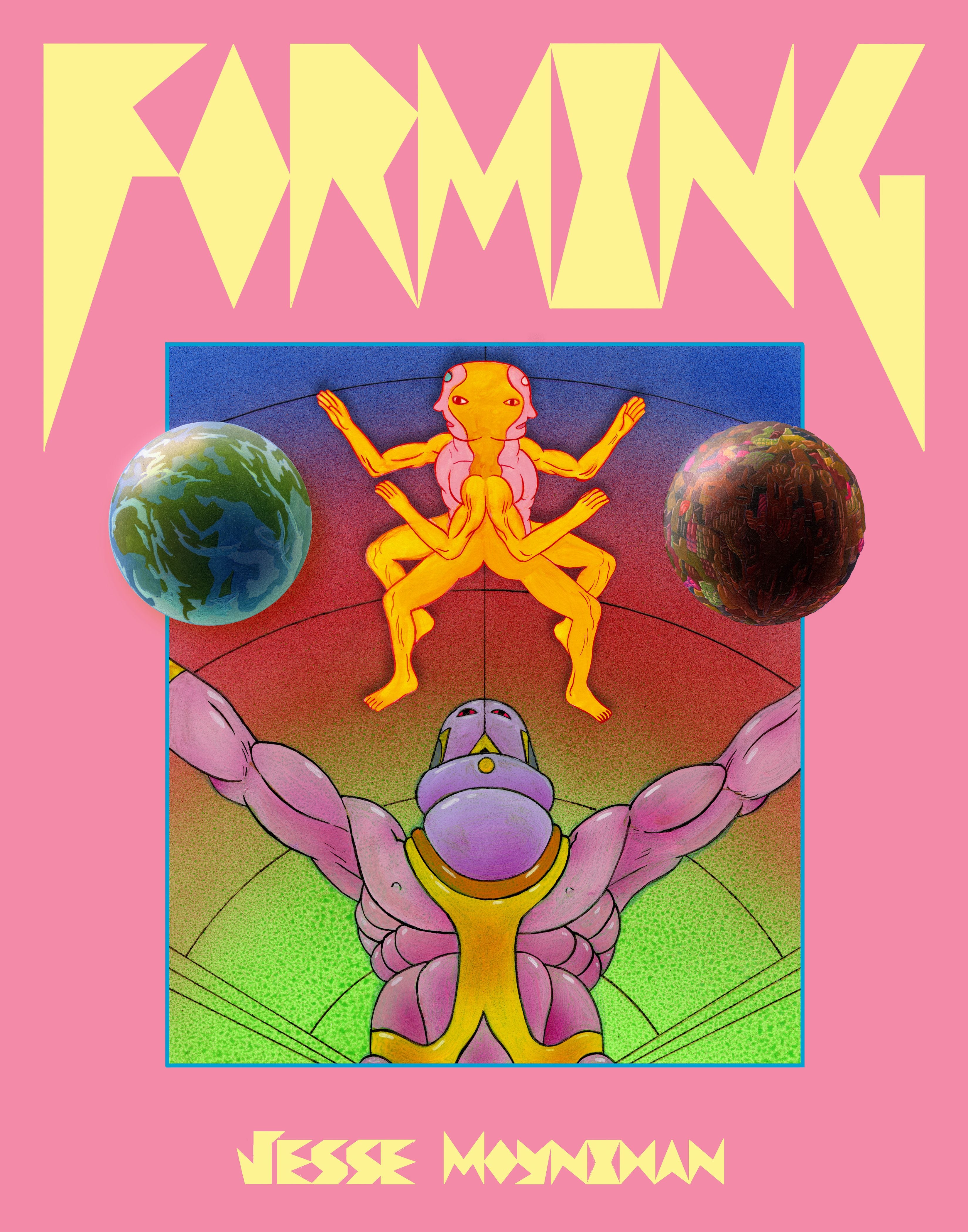
Jesse Moynihan, 48, grew up outside Philadelphia in the Delaware County orbit he and his brother would later diagnose as cursed, studied film at Temple, spent five years behind the counter of an art-house video store, and drew comics the whole time. He ran a strip in the Philadelphia Weekly, won a Xeric Award for The Backwards Folding Mirror, played in the band Make a Rising, and then spent six seasons writing and storyboarding for Adventure Time, where he was responsible for the show’s headiest episodes: “Sons of Mars,” “The Mountain,” “Astral Plane,” and “You Forgot Your Floaties.” He was art director on Netflix’s The Midnight Gospel, made the animated shorts Manly (with his brother Justin) and Jesus 2 (which screened at Sundance), and recently storyboarded on Adventure Time: Side Quests.
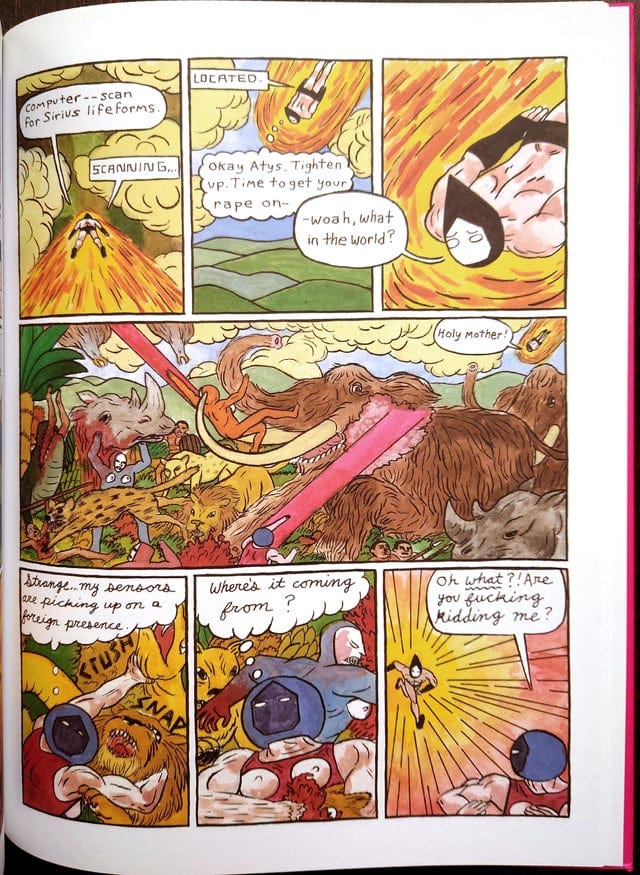
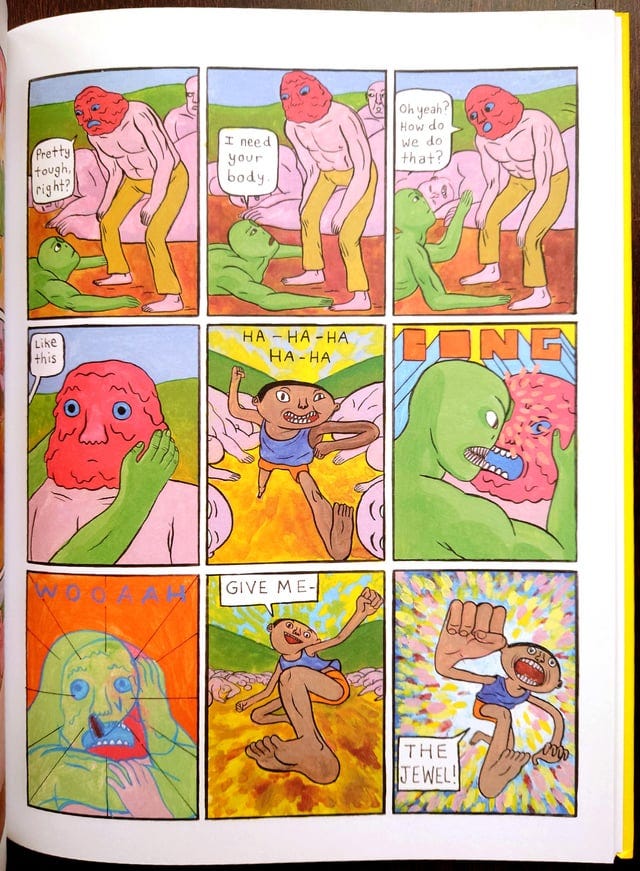
Through all of it, Jesse kept returning to Forming, the cosmic epic he serialized for free on his website from 2009 to 2024, painstakingly painting the pages. VICE (they used to be a big deal — I worked there!) called the collected volumes “a big crazy Jodorowsky-style reinterpretation of Bible tales and mythology mixed in with lots of funny swearing and pretty colors.”
On October 6, Fantagraphics publishes the complete Forming as a 448-page full-color hardcover. You can support Jesse’s independent work, including an in-progress animated adaptation, at his Patreon.
OLIVER BATEMAN
Folks, welcome to another episode of Oliver Bateman Does the Work. Today we’re back on the comic book beat. We’ve had Aubrey Sitterson and Alex Graham on here before, and Howard Chaykin’s hopefully going to come on at some point. Right now I’ve got Jesse Moynihan, who a lot of you know from Adventure Time, great episodes like “The Mountain” and “You Forgot Your Floaties.” But today we’re here to talk about what happened when my friend Tucker Stone sent me this amazing compilation of your long-running comic Forming. I was blown away. Anyone listening who sees that Fantagraphics is putting this out should just buy the book. It’s 450 pages of incredible color and religious imagery, and I went in not knowing what to expect. The scale is epic, but it has that intimacy people who watch Adventure Time might recognize. There are actual friendships in the book that feel oddly real. There’s also wild imagery, lots of sexual imagery. A real work of id. What’s the story behind this thing?
MOYNIHAN
Before Forming, I was doing autobio-style humor comics. They were surreal, almost me talking to myself, diary stuff, but everything spoken through symbolic, poetic jokes. I was trying to make people laugh, but in a really insular way. I had a comic strip in the Philadelphia Weekly for a while. A small publisher put out one graphic novel of mine, which was basically a documentation of a breakup I was going through, told through the lens of this gnome-looking character I based on the Nation of Islam’s mythology of Yakub.
OLIVER BATEMAN
Oh yeah. Big head.
MOYNIHAN
Yeah. I had heard their mythology and thought, wow, that’s really fascinating. So my headcanon was that this character had gone through all that, creating the white race and everything, and now he was living a normal life, trying to be a domestic, normal Philadelphia indie rock kind of guy. I never talk about that, but that was my canon. I was always interested in fringe mythologies. And I loved the old undergrounds, Robert Crumb, and Peter Bagge’s Hate was a huge influence on me. Confessional underground stuff.
I was doing conventions, self-publishing, and my friend Dash Shaw, who doesn’t even remember this, told me about my last graphic novel. I’d said, no one bought it. People pick it up at conventions, flip through, put it back down. It’s like speed dating, you get rejected over and over, because unless someone big advocates for you, no one’s willing to read navel-gazy black-and-white comics in good faith. And Dash told me, I’m paraphrasing, that I was stuck in this old underground paradigm, and I should try to move forward aesthetically, do something besides that tradition of confessional comics.
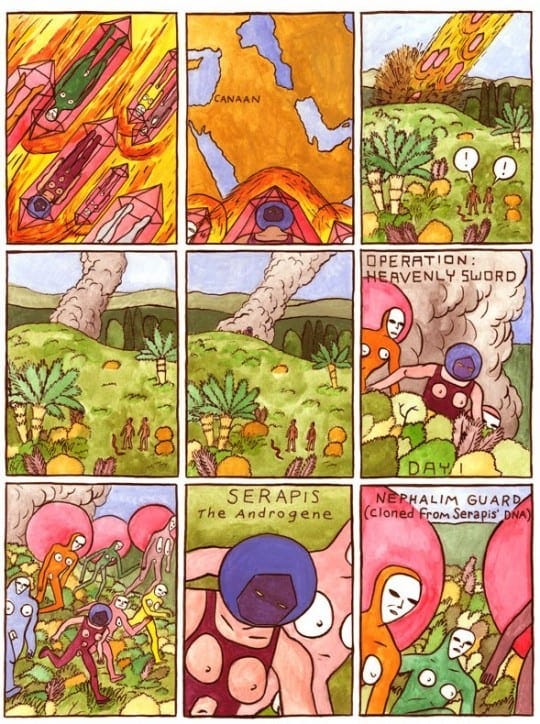
So I said, okay, I’m going to make my blockbuster book. I’m going to work in color. I’m going to put it out on the web for free so anyone can see it, and it’s going to be the most thematically ambitious thing I can think of. But because I come from that background of confessional, personal autobio comics, that’s always going to be in there. All the characters are based on something I’ve experienced or witnessed up close. It’s all grounded in some emotional truth from my life, and then I turn that into sci-fi, mythology, religious exploration.
OLIVER BATEMAN
That shift between the high cosmic register and low personal communication makes you care more about the characters. There will be this huge cosmic fight, and then it’s “dude, come on, man, I’m just lonely, how are you doing?” It seems odd at first, but it’s consistent throughout the book, and you realize these are bros, these are friends, you can tell why Rhea’s mad. And so does the color. The color is phenomenal.
MOYNIHAN
Oh, thanks.
OLIVER BATEMAN
You don’t get that level of color in an indie work, generally, due to resources.
MOYNIHAN
Right, well, webcomics blew that up. I was doing black and white early on because printing color was cost-prohibitive. But as soon as I could put my stuff on the web, I could start painting, and I hadn’t painted since high school. I had a really good high school art teacher who taught me color theory, and everything after that was black and white for years. So I bought a gouache paint set from the art store, and at first I treated the color like watercolor, putting down washes, filling space. Then once my confidence came up, I got more expressive. A tree doesn’t have to be brown. A tree could be emotional. It can be purple or red depending on how I’m feeling. The color became part of the symbolism of the book. That’s why I put that color chart at the end, to explain my thinking about the symbolism. It started happening later in the book, and I got way more into it.
OLIVER BATEMAN
Did you have this whole cosmic journey in mind from the start? Some of the elements sync up very well.
MOYNIHAN
I did a fair amount of pre-planning. I was writing outlines and researching for months before I started. Then my process was to storyboard maybe 10 to 20 pages at a time based on the outline, and as I storyboarded, I’d riff within its confines. I didn’t want to get bored. But riffing starts morphing the outline, so I’d have to rewrite it. I probably fully rewrote the outline five times. I’ve got huge stacks of notebooks of storyboards and notes in my studio.
There’s a lot of synchronistic stuff happening in the book. It’s a fifteen-year project, so there’d be chunks where I’d take months off, come back, and have to remind myself what the story was even about. Luckily I was posting it on the web, so I had people correcting me in the comments section: “that guy’s green, why did you draw him this color?” But thematic connections would develop, and I’d think, oh, this connects to this. I’m forming connections as I write and draw. I always think in a circular way when it comes to story. Everything is constantly moving forward and looping in on itself, and I trust that’s going to work because it’s all coming from my own real way of thinking. I’m not trying to construct the ultimate external spiritual sci-fi Dune world. It’s all coming from within, basically. So I can trust my intuition and not have to be so organized about it. These synchronicities are going to pop up. Whether that works out in the next batch of shit I do, we’ll see, if I’m still in touch with myself when I decide to do another epic thing.
OLIVER BATEMAN
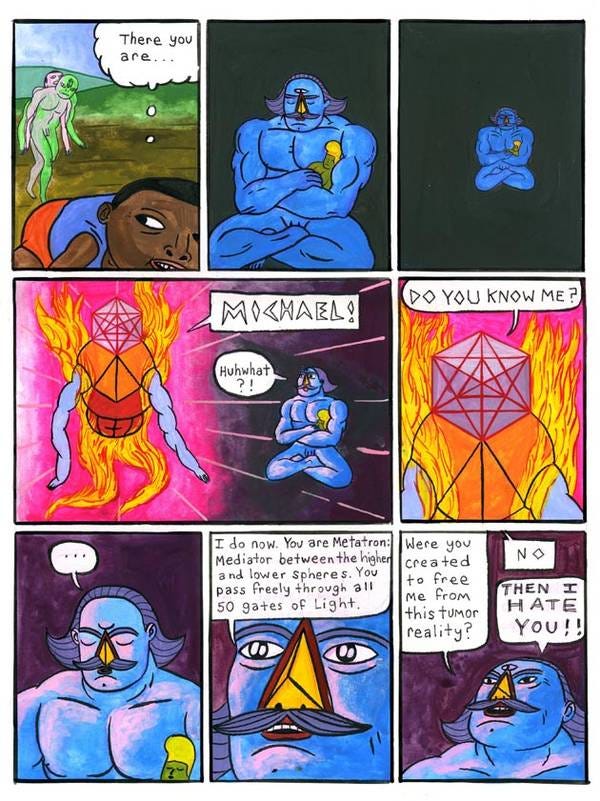
There’s a type of work that’s just lore-saturated, lore on the page footnoted with more lore, and that’s fine. But here there’s a balance between the cosmic and the personal, with hints of larger lore you never linger on. There’s probably a ton of headcanon behind each character that you don’t need to share. Like why it’s important that Michael has a beard at this point and the mustache at that point. It’s clearly significant.
MOYNIHAN
Well, the beard and mustache thing, this is actually bad because I’m on video right now and you can see I’ve grown my beard out. But I used to always say, if you saw my mustache growing out, you knew I was depressed.
OLIVER BATEMAN
A lot of guys can get that. If you’re letting it go one way or the other, you’re in a bad way.
MOYNIHAN
And I was connecting it a little to my memory of the Samson story. I always loved that story as a kid, so it’s probably something to do with that too.
OLIVER BATEMAN
What were some of the visual inspirations you were taking? The characters’ heads are great. One guy’s got a gemstone for a head, and the Nomo heads in book two, green and red. Where’s that coming from?
MOYNIHAN
At that point I was definitely being influenced by Mat Brinkman, the whole slimy Fort Thunder scene, everything grippy and psychedelic. When the Kramers Ergot anthology came out, probably Kramers Ergot 4, not all of it was Fort Thunder kids, but a lot of it was Brian Chippendale, Ben Jones, CF, Mat Brinkman especially. I saw that stuff and realized I could be more abstract, push my character designs in more fun directions. Some of my design ideas from the early 2000s I’m still doing today. I draw lots of goopy, intestine-looking creatures. I’ve been doing that for thirty years.
And the Fort Thunder people were coming down from Providence, even the noise scene, Lightning Bolt and all those guys playing shows in Philadelphia, where I was living. Everything got really patchworked, super loud, neon. That had a heavy influence on me and on a lot of people. I realized I could pick from all the colors in the paint bucket. And there were people like Yuichi Yokoyama appearing on the scene doing really cool character designs. Everybody showing up at the Brooklyn indie conventions at the time, there was so much interesting, energetic stuff happening. You couldn’t help but be influenced by it.
OLIVER BATEMAN
What’s amazing is that with all of that in mind, you keep pretty tight narrative control. Not that it doesn’t sprawl, but when you read something like Puke Force, there’s less narrative direction there, and it doesn’t have to be one to one. You keep the line together.
MOYNIHAN
My one issue with those guys, and even with people like Jack Kirby and Jodorowsky’s books, The Incal and everything, well, Jodorowsky could tell a story, but everything for him is archetypes. And for people like Brian Chippendale and CF, they were following stream of consciousness. Their narratives are navel-gazing, almost talking to themselves, but the artwork is so explosive and cool that you forgive it and go along for the journey. But I’m a film guy. I wanted to be a filmmaker.
OLIVER BATEMAN
That’s what you went to school for, right?
MOYNIHAN
Yeah, I went to film school. And when I was in film school I worked at an art-house video store, whatever Tarantino-adjacent origin story, I worked at this video store for five years, watched every movie, studied film, and wanted to be a live-action filmmaker. But I was drawing comics the whole time, my whole life. And one day it clicked: I’m not going to make films, I’m going to make comics. It costs ten bucks for a pad of paper and some ink instead of $10,000 for a student film. Being a struggling college student, I couldn’t do it. So I gave up on the live-action dreams, but I still had that structural screenwriting DNA in me. I wanted to tell coherent stories.
OLIVER BATEMAN
That’s what makes this thing so remarkable. It’s an enormous book in its finished form, but it’s paced like something that could be filmed. There are some great fights, like when Rhea’s fighting the gnome guy. The bodies are elongated and strange, but just like in Adventure Time, you can clearly track what’s going on.
MOYNIHAN
I’m mostly using film rules for tracking action, screen direction and stuff like that. I think that’s why I got hired on Adventure Time. When Pen read my stuff, he could see I understood film language, so I could transition to being a storyboarder pretty easily. With comics there’s so much forgiveness from the reader. You can jump time, read Scott McCloud. Every single panel can be a completely different way of viewing a scene, and only the most avant-garde filmmakers work with the form that way. A Marvel film is never going to do the things a lot of comics do regularly with narrative structure and staging. But because I came from film, that part of me is a little more conservative. I stage things in sequences that have logic to them. I’m basically a storyboard artist, and I’ve been one for most of my life.
OLIVER BATEMAN
Which means a reader like me can sit down and read the book in a sitting, because it plays out like a film over a set amount of time. Anyone who sees it and thinks it’s intimidatingly long for a color book: not really. It keeps pulling you toward the next thing, lots of cliffhangers across the plot lines. I find it interesting when I see that balance in any art, where somebody has imposed controls through their training but is cutting loose here and here and here.
MOYNIHAN
I think it’s just easier for me because my whole childhood was Marvel Comics. Superheroes, X-Men, even the extreme era, Rob Liefeld and Todd McFarlane. Spawn was the tail end of my interest in superhero comics, but I loved Spawn. And those are meat and potatoes: tell a story, make a quote-unquote great drawing. I’d say I’m still influenced by people like Simon Bisley.
OLIVER BATEMAN
His Lobo stuff is the platonic ideal of a mainstream comic. I can’t believe that came out pre-Vertigo. And Keith Giffen plotting those books, an artist who could really plot and storyboard.
MOYNIHAN
Those are just candy. You munch them down and you’re never confused about what’s happening. The most eye-catching drawings, told within a story that flows. So I have that comics blockbuster storytelling in me as part of my childhood, not just the heady indie stuff. Highbrow, lowbrow.
OLIVER BATEMAN
You figured out as well as anybody how to do that. Adventure Time as a collective project reached way more people than you’d think, and then you watch it and the stories are coherent across the runtime. The art is odd in parts, but the stories cohere.
MOYNIHAN
The Adventure Time writers’ room, especially early on, was: everything’s got to be three-act structure. You’ve got executives giving you notes if you divert from it. What’s the story about, what’s the engine. A pretty conservative style. You’re part of a machine and a tradition of kids’ television that everyone follows, the same at Nickelodeon or Disney, and there were people put in place to make sure Pen wouldn’t veer too far, because Pen wanted to make episodes with no plot, just hanging out and doing random shit. No structure whatsoever. If he could have done that, he probably would have been happiest. But early on there were veterans installed who knew story structure and would say, no, you can’t, this joke is unnecessary to the plot. And the artists within those writers’ rooms keep pushing against the edge of that. Eventually nobody was watching or giving notes anymore, but we had all been trained up that way. There’s a reason those things exist. Three-act structure is really useful for short-form television. It keeps a viewer engaged. But it’s fun to mess with it.
OLIVER BATEMAN
A lot of times the endings would be quite poignant. You’d have madcap stuff and then this unexpected poignancy, and it seems like only the format allowed that to happen. The great children’s cartoon of my childhood was the John Kricfalusi Ren & Stimpy, and he was always battling Nickelodeon, and the art that comes out of that conventional structure is great. Though you’re probably right that fewer people would watch characters just hanging out. I’d sit through it, as a fan of artsy stuff, but the numbers would drop.
MOYNIHAN
It becomes a thing you have to engage with in good faith, and that’s the upper tier, the small percent of media consumers. Everyone else, it’s like that movie Sullivan’s Travels. It’s about a highfalutin, artsy screenwriter who wants to make message films, so he goes out to experience life, be homeless, ride the trains, figure out what life is about. And at the end he’s in a movie theater secretly watching a crowd laughing at some dumb get-kicked-in-the-balls comedy, relieving themselves of the burdens of life. Mostly we’re just here to entertain. People want to chill after a long day of work and watch something they don’t have to do academic research to understand. But then you add this extra layer of something poetic or meaningful, just in case, and they’re sitting in this passive state and they wake up: wait, what just happened? To me that’s the two things working in tandem, not against each other. Hopefully.
OLIVER BATEMAN
That’s the message of Barton Fink too, where the Clifford Odets-style leftist meets John Goodman’s character, and what kind of movie does he want? The Wallace Beery wrestling picture they want him to make.
MOYNIHAN
I think the Coen brothers are one of the great examples of making something most people can get into, entertaining films that are also elevated auteur films at the same time. Barton Fink is one of their more difficult ones, but then you have No Country for Old Men, a crazy, straight, gripping thriller, and Fargo. I try to do that. Though I’m describing my ideal state of mind. I also have my resentments toward doing mainstream stuff, hand-holding and things like that. So I’m always wrestling with how to tell a story in a way that’s artistically satisfying while still tracking. Because art and storytelling are mostly about communication. I’m trying to connect with the audience, not alienate them. I’m not trying to be pretentious, or classist, where only a certain echelon of people gets what I’m doing. I want everyone to get what I’m doing. But at the same time, I’m not trying to make slop.
OLIVER BATEMAN
We need people grappling with that, because that grappling is the only limiter on this stuff. Especially now, with the pressures of the format and the streaming options, when it’s easy to just stamp out another one.
MOYNIHAN
As far as the indie creators’ work mill, you constantly have to be putting something out, reminding people you exist. So you kind of have to downgrade the quality of your work to output something every other day. It’s like we’ve become our own sweatshops.
OLIVER BATEMAN
Which stinks, because sometimes the thing needs fifteen years. And I read the end product in a day.
MOYNIHAN
Hopefully it percolated. That’s the goal. It is funny. A page would take me anywhere between eight and twenty hours depending on the detail, and early on, when I had lots of energy, I was posting three pages a week. Crazy amounts of work, busting my ass. And then you post it and people read it in about thirty seconds. If they read it at all. So the hope is it resonates, that they read it in thirty seconds but they’re thinking about it later.
OLIVER BATEMAN
The shock for me wasn’t that the story grips or even that the art is good. It’s that there’s this longer-term resonance in scenes where a character is feeling pitiful or wondering what the hell is going on, and it lingers with you. That’s what the time the creator takes with a work imposes on it.
MOYNIHAN
There were long stretches where I didn’t work on it, especially in the latter third, because I was a very different person than when I started. When I started, this is 2008 or so, I was on a rocket ship. I was going to disappear into the forest and become enlightened. Do all this research, figure out the correct way to think, the correct way to meditate, do my spiritual practice to the point where I just dissolve. Basically the character of Michael. And the character of Noah. That was my headspace.
OLIVER BATEMAN
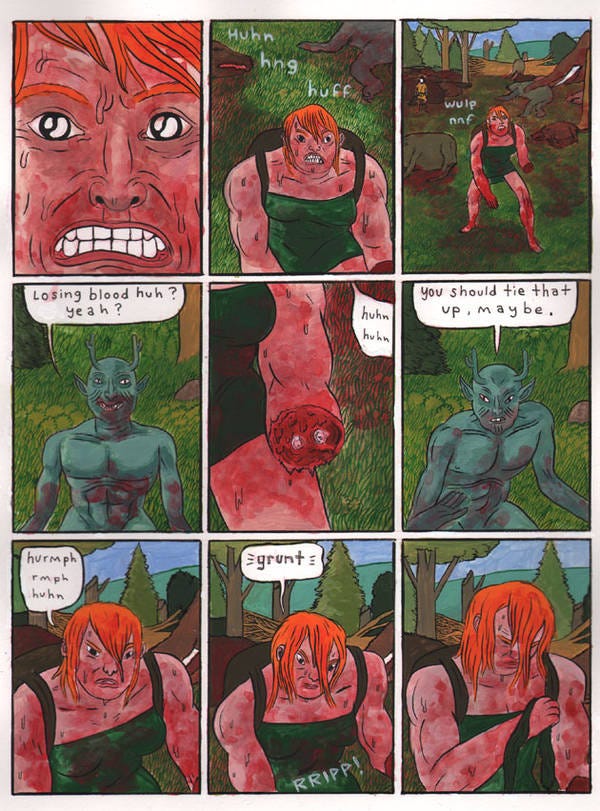
They’re both leaving the world. The Noah saga is great, and eventually he gets the bee ring, and that finger getting gnawed away is a nice creepy little visual. Those things stick with you. That, and the fact that just about every character has genitalia. The animals, the people. The secret base has genitalia.
MOYNIHAN
Early on, when I worked at that video store, I used to watch this Philip Glass opera documentary all the time, about Akhnaten. There are interviews with Glass about why he was interested in the story, and basically, Akhenaten might have been intersex, might have had both genitalia, and that’s part of why people considered him a god. And that dovetails with the mythology of the angels being both men and women, the androgyne, all that stuff in alchemy.
OLIVER BATEMAN
Jodorowsky loves that stuff too.
MOYNIHAN
So then I started thinking, okay, Adam created Eve from his rib, so Adam and Eve are basically the same being, and the further back you go, the more the genders combine. It’s like Dragon Ball Z, the same Rob Liefeld combos. The more comboed out you are, the more power you have. That’s the whole theme with the Assassins Guild. So I had to show the genitalia to show what’s going on with that idea, which all stems from me watching a Philip Glass opera documentary.
OLIVER BATEMAN
You’re adapting this for animation now. You’re going to have to cut some of that, probably?
MOYNIHAN
The guys helping me make it don’t want to cut it. I don’t know where we could air it. It’d be rated X.
OLIVER BATEMAN
The secret base where the assassins live has genitalia. That’s Adventure Time on steroids right there.
MOYNIHAN
Sometimes when I’m making stuff in my room I’m not thinking about the consequences later. I’m just rubbing my hands together: this will be cool. And people say, there’s so much dick in your book. I’ve never counted.
OLIVER BATEMAN
One of the best jokes in the book is also part of the secret base, where getting in is handled like a call center.
MOYNIHAN
I was trying to replicate this idea of prostrating yourself at the gates of the temple. I heard some old Buddhist story where, to get into the monastery, you have to be outside on your knees for weeks in the rain. How would they keep him from getting in, and how would they make it as miserable as possible? For me, that’s being on a phone call with my insurance company.
OLIVER BATEMAN
That was a great bit. And there’s the other bit where a character is trapped in the center of the earth and all he cares about is doing crunches. Getting a little jacked. Then he points out that even though he’s done that, he’s not really strong, the muscles are just for show. That’s the kind of tossed-in dialogue that sets up the really profound moments, like the character who transforms into a lion man by the end of the book and eats his father. If you had that whole angle plotted out, that’s when it gets really trippy.
MOYNIHAN
I have lots of notes on that. And when I go back and read my notes on why I came to that conclusion, I barely understand it. At some point in my life I understood what I was getting at. A lot of it is dreamlike, in the moment. I’m doing all this research on symbolism and world religions, and I start putting pieces together, this connects to this. Doing my own mini Joseph Campbell research. That’s really where it all started, me being into Joseph Campbell.
OLIVER BATEMAN
This is the hero with many genitals. For me it reads like the weird mythology of my generation mashed up, everything from The Infinity Gauntlet to indie comics wedged in with all this other stuff pulled from the background. And it’s the kind of thing, and I want your opinion on this because you’ve worked in all the media, that I don’t think AI could do. I say this as someone whose day job is head of AI content for a company. I make rules all day to keep this stuff at bay. But I don’t see how on earth AI art could do this book. I don’t see how it could do Adventure Time, even.
MOYNIHAN
I used to have a theory, but my theory got disproved, basically. My original thought about generative AI art was, okay, even if you could replicate Jodorowsky’s Holy Mountain and generate your version of it, what you don’t have is the story of the person making it. To me, art is human aspiration. There’s a narrative that has to exist. Van Gogh. Even in sports: Kobe Bryant. You watch sports because you want to see the extent of human potential. It’s similar to punk music. You see the Clash play and think, I could do that too, though maybe I couldn’t write a song as good as London Calling. You see yourself in someone like Van Gogh, and you see his story, he was depressed, he got through it enough to make these paintings that are now eternal. You need the John Henry story behind the art for people to resonate with it. Otherwise it’s forgettable. The image has no meaning.
And then I’m seeing these AI Banana Fruit Love Island things get a billion views on TikTok, and I go, okay, there goes my theory.
OLIVER BATEMAN
Those ones, yes. Amazing stuff.
MOYNIHAN
But I still collect vinyl. There are always going to be people that matters to. There are always going to be art heroes and sports heroes, any human occupation where people at the top are looked up to by people coming up, and that has deep meaning for them. You can’t get that from AI. There’s no aspiration involved except the aspiration of developing it. Nobody who grows up watching the Fruit Island stuff is going to be talking about it in twenty years the way people talked about Nirvana.
OLIVER BATEMAN
You’re totally right. Nirvana’s songs have faded for me, but the moment of Cobain on MTV Unplugged lingers way longer. I grew up on Henry Rollins, and his music’s just okay, his voice was pretty much shot after a certain point, but his persona in the eighties and nineties was cool.
MOYNIHAN
And the story, the fan, and all that. There are so many Rollins interviews that are very entertaining. I think generative AI stuff is useful for topical, in-the-moment social media parody, basically. It’s disposable. It gets the idea across and people move on to the next thing. I don’t think purely AI-generated stuff in vertical reels is capable of having resonance.
OLIVER BATEMAN
I’ve seen some now reaching five and ten minutes, the blue laser things. They shoot the blue lasers. Okay, great. I’m not going to watch that.
MOYNIHAN
I haven’t seen anything that hooks up. On LinkedIn, I don’t know why I doomscroll LinkedIn, you see people who were fairly successful indie filmmakers making AI films. “I made a full five-minute AI thing with this grant I got from some AI company.” Okay, I’ll watch it. Bro, this shit is not holding together.
OLIVER BATEMAN
You would know better than anyone, because you came up in the storyboard world. AI is not going to do an Ozu film where the exits and entrances follow his rules.
MOYNIHAN
Even the stuff my friends love, I look at it and it feels like it’s diminishing my soul. Sometimes it’s a curiosity, like the Brad Pitt and Tom Cruise fight thing that came out, which was pretty convincing. From a technical standpoint, that’s interesting. But I don’t get anything beyond that. And maybe I’m looking for something beyond that and a lot of other people aren’t. Even before AI, that’s been true of media. One of the reasons I wanted to be a filmmaker originally was seeing Evil Dead 2 and the camera flying through the house. You could tell there were two dudes with a dolly running through a house. You knew it was two guys holding a camera. But it looked so cool. You feel the tactile filmmaking. That movie is about the people behind the camera making it. So I got a VHS camera and ran around my house trying to mimic Evil Dead shots. For me, looking at other people’s art is inspiration to make art. Maybe I just don’t understand the point of view of someone who loves the entertainment and doesn’t care where it comes from, because I’ve been drawing my whole life.
OLIVER BATEMAN
Right, and there was always mid, even before the word existed. Sometimes my wife will be reading one of those throwaway books everybody’s reading, and I ask, do you think it’s good or bad? Do you like the main character? “Well, she’s a little pushy.” So why do you read it? “Passes the time.” I’ve never approached anything that way, so it’s alien to me. But I get it.
MOYNIHAN
I’ve gone into that mode here and there. I watched the first two or three seasons of Emily in Paris. I’m not innocent of consuming slop. And in some of the lowest forms of art you can find something. I have a bad movie club. My friend Jeff curates god-awful movies every Wednesday, these outsider films you can barely sit through, and there’s always something in there where you can feel the passion of the creator, something that meant something to them. Even the guy who made all those video game movies, the German guy, considered the worst filmmaker in the world for a while.
OLIVER BATEMAN
Uwe Boll. Those movies are shit, but there are good elements to them.
MOYNIHAN
There’s always something in there where you think, that’s kind of interesting. When I was younger I was the opposite. I’m not consuming anything that isn’t the highest-caliber art, I only watch the best movies, I only read the best books. Which now borderlines on some sort of fascist thing. I’m a lot more forgiving about media these days than I was in my twenties.
OLIVER BATEMAN
Speaking of finding something in the low forms: I’ll watch old, bad pro wrestling, and there’s still a moment where you go, this guy’s kind of a sublime actor in a weird way. The aesthetics are perfect. You couldn’t do better camp. And you grew up going to the shows at the Spectrum.
MOYNIHAN
I have memories of how affected I was as a child when Shawn Michaels threw Marty Jannetty through the window on the Barber Shop set.1 It ruined my day. And then Jannetty just never came back, and you find out later it was because he was such a fuck-up that they fired him. But I didn’t know that. I was just, how could he betray his tag team partner? It was such a resonant storyline for me. The Macho Man wedding stuff too. I did think Miss Elizabeth was the most beautiful woman in the world.
OLIVER BATEMAN
Wrestling could make you believe that. Who could be more beautiful? And I’ve covered those guys, my books are about those guys. They were consummate pros even at the bottom of the card. You meet them today and they can still lay out a two-minute radio promo telling you where the show is, who they are, and why they’re fighting. A pro at something with no insurance and no money, but a pro.
MOYNIHAN
I used to listen to Roddy Piper’s podcast for a while. His stories were gnarly.
OLIVER BATEMAN
He came up as basically a carny, and he loved the scum world of pro wrestling. When It’s Always Sunny in Philadelphia brought him in, he nailed those roles because that was the character. But back to AI for a second, because in my day job I handle the work of an entire content team that would have existed once upon a time. And it’s not like anyone liked writing corporate white papers. We all hated it, so it got consolidated into somebody.
MOYNIHAN
I don’t know what the endgame of our current capitalist structure is, but it seems like all these companies are running on debt, hemorrhaging millions of dollars every day. None of them are profiting, as far as I can tell. At what point can we not afford to sustain any of these companies? I’m not an economist, but I think they’ll all have to downscale big time, and it might just end up being one of those things where they help you with spreadsheets.
OLIVER BATEMAN
That’s actually their best use. A more functional version of what Copilot was promising. You’ll be able to run teams with fewer people. That’s how we use them. And AI transcription is useful. I was reading the Elephant 6 book, and Adam Clair typed out all those interviews by hand in 2020. Two more years and there would have been tools to at least capture the text. But at most, that’s what they can do, and they’re being sold on the promise of curing all the cancers.
MOYNIHAN
I follow a lot of video game stuff, and even the idea of upscaling video games with AI is causing the cost of games to triple. Their desire to have the best AI technology is undermining their own business. No one is going to buy a $1,500 PlayStation. I’m holding on to my computer setup for as long as I can. A $600 hard drive? What the fuck is going on, dude?
OLIVER BATEMAN
None of it makes sense. In 2015, 2016, you could build incredibly powerful systems with parts, then this rush for parts happened. And the funny thing with games: my daughter is six, and what she likes is a pixel-art game where she can walk the sprite around the map, 2D, no transitions, the old Pokemon FireRed. And I’ve moved back into that too. I’m still playing emulated GBA games. The art is great. All I need are the symbols and the representation. I don’t need to walk through GTA 6.
MOYNIHAN
I really think people have started to figure out that it’s all about gameplay and not graphics. Graphics are cool, but number one is gameplay. You can have the most lo-fi art.
OLIVER BATEMAN
Like Undertale, which is a great game.
MOYNIHAN
Amazing game. And that poker game that came out, the roguelite.2 Like Slay the Spire. You understand the gameplay, it’s addictive, and it doesn’t matter that the art is whatever. I’m personally not interested in Grand Theft Auto 6. I bounced off Red Dead Redemption 2. I’m carrying a bear pelt around for an hour. That’s not for me. There are open-world games I like, but ones where the gameplay is immediate. Elden Ring is one of my all-time favorite games. I played through it twice. You don’t get into scrolling through a book of items rendered as if you’re flipping the pages of a real book. Red Dead, I go to a general store and I’m like, do I need nails? I don’t know.
OLIVER BATEMAN
It’s the same as Skyrim. That’s when I first started noticing I was done: there are so many books in Skyrim, all that lore. I had a friend reading all of them. I wrote a piece for the Paris Review about how I don’t read the books in the video games.
MOYNIHAN
You don’t need to pick up books and read more. You can world-build through the environment. I really think that’s a lazy game-design conceit, books.
OLIVER BATEMAN
It’s fun for the writers, but that’s something you could easily assign to AI now. Tell me the Legend of Krillandia.
MOYNIHAN
Well, a lot of those guys are doing that. I worked on a show for a tech company for a while, and they were so into generative AI, building a lot of the lore around their world with it. I was writing for them, so I had to go in and read all the AI lore they’d generated and plus it up, because this stuff is meaningless. You’re just filling space. It’s not interesting or fun or funny. So I’m pretty skeptical even of that. Maybe if you’re building a huge open world and you need character archetypes that respond in real time, procedural dialogue, because you can’t hire enough people to write that many dialogue trees. Maybe something like that. But I’m always thinking, maybe just scale down. Some game designers’ North Star is the ultimate simulation of life. Okay, that’s a goal some people have. But if you want to make a fun game, you don’t have to make the biggest game. There are decades of great games that were smaller scale.
OLIVER BATEMAN
I basically need the minimum amount of lore. Even with Forming: if there’s more lore that book needs, I’ll just make it up. I can shove it in there in my own head.
MOYNIHAN
Exactly. That is the relationship between the author and the audience. If you leave it open enough, the audience starts to connect the dots. They build their own headcanons, and that’s part of the relationship. If you have all the lore dialed in and every question covered, there’s nowhere for the reader’s imagination to go. They’re just passively experiencing the thing. In film, it’s just moving pictures and your brain ties them together to make the illusion of motion. It’s the same in storytelling. You have these gaps, and not filling all of them is part of what makes the world feel lived in.
OLIVER BATEMAN
I came up off Final Fantasy 6 web rings, writing fan fiction and fantasy e-wrestling by email in the nineties, and that stuff was shit writing, but I needed the reps, and I was filling in the gaps. Only later did I learn there were cartridge limitations that led to the text being so spare. The writer made it open-ended because he couldn’t tell you. Now you go to a Final Fantasy game and they lock it all down.
MOYNIHAN
Their lore is schizophrenic now. You play a Final Fantasy game and you’re like, what are you talking about? And the opposite side is anime lore, which is so thoroughly thought through. That’s the opposite of the way I think about storytelling, but sometimes it works, and that proves to me there are all sorts of ways of doing things. I don’t know if you ever watched Hunter x Hunter. That show is the prime example of tell-don’t-show. It’s a lore fest, episodes of internal dialogue, and I fucking loved it. Okay, this breaks all my personal rules about storytelling, but it still works. You can find a good way to do the wrong thing, quote unquote.
OLIVER BATEMAN
So what’s the timeline? The book drops October 6. Do you think an animated movie could come out at some point?
MOYNIHAN
I’m going to go on tour for the book, and I just finished storyboarding an adaptation of the first section, basically up to the point where Mithras lands on Earth. I do it slightly out of sequence, because the creation of the universe comes a little later in the book, and I thought it would be cool to start an animated adaptation with the creation of the universe. Good hook. So it’s 22 minutes, and the first 15 minutes or so are just Michael and the devil fighting each other.
OLIVER BATEMAN
That’s great stuff in the book, too, for fans of that kind of thing.
MOYNIHAN
So I’m going to tour the book and screen this rough animated version, black-and-white drawings timed to sound effects, and read it as it goes, to see what kind of response it gets. I’m working with this company called Bardo, and I think they’re going to animate bits and pieces of it, and then we’ll try to find financing. We’re talking to Europeans. The Europeans still care.
OLIVER BATEMAN
That’s what everybody tells me. The European folks I work with at my company still aren’t using AI, by and large. They’re not bought in.
MOYNIHAN
Europeans still like experimental animation, and they love comics. In a lot of ways that’s where the financing is, so we’re trying.
OLIVER BATEMAN
And Adventure Time is rolling along with the Side Quests thing.
MOYNIHAN
I don’t know if they’ll get a second season. We’ll see. I did some storyboarding on that, and there are still episodes they haven’t released. Luckily, Adventure Time keeps making spinoff shows and they hire me to help, because the animation world is extremely sparse when it comes to jobs right now. I was really lucky. The first show I ever worked on went ten seasons, which doesn’t exist anymore. So I’ve been focusing more on my own stuff, like a lot of other cartoonists, which is nice because I always just wanted to do my own stuff. It’s just that now I’m doing it because there’s no choice. There are no cushy union jobs anymore.
OLIVER BATEMAN
I’ve talked about this with other people who’ve come on the show, but I increasingly feel like Dave Sim of Cerebus fame, crazy man that he was, had the right idea all along. Just pump out your own stuff.
MOYNIHAN
He wrote that pamphlet about how to self-publish. I bought that book and I studied it, and that’s how I got my start in comics. He was probably the first really rigorous comics author-artist I noticed, early nineties. I had all the phone books. They might be in a box in my parents’ house.
OLIVER BATEMAN
They’re all on the Internet Archive for anyone listening, downloadable for free, every one, and not pirated. I think it has something to do with the way he distributed them. Boy, did he do great work on the Chief, him and his collaborators. The bang for your buck in those graphic novels is insane.
MOYNIHAN
I had all the phone books up until a certain point. I lost interest when it started becoming all text blocks.
OLIVER BATEMAN
Reads is the one that slowed me down. Melmoth was still really good, because that Oscar Wilde character was really good. And he’s a great letterer, the lettering is excellent, but there gets to be a lot of letters.
MOYNIHAN
And then he’s beefing with Dark Horse at some point, and I’m like, what are you doing, dude? But I did come back for the end. I bought the last issue.
OLIVER BATEMAN
Cerebus pulled up into the light. That’s a bang finish, even if the bottom half of the middle is bizarre.
MOYNIHAN
I was definitely keeping track of the spectacle of his life through the Comics Journal, the proposed boxing match with Jeff Smith and all that. Free social media. That might have actually happened at this point. Jake Paul might have hosted it.
OLIVER BATEMAN
I’ve got to give Jeff Smith credit, though. Much more economical drawings. Dave Sim was grinding, and then his Alex Raymond book, his hand became arthritic. I’m not doing all that work. God bless him.
MOYNIHAN
That’s another reason I switched to color. My early stuff was so heavy on crosshatching that I was destroying my hand. And Jeff Smith, early on. You know, I used to go to this comic book store called Showcase Comics in the Granite Run Mall outside Philadelphia, and those guys were super into me and my buddies showing up, and they’d recommend stuff. They got me into Cerebus, they got me into Bone, Jim Woodring, all that Tundra stuff, because of these dudes at the comic store.
OLIVER BATEMAN
Those people are the unsung heroes of art. Record store people too. The generation coming up behind us may not know these people existed.
MOYNIHAN
I was a mall rat. Every Friday, arcade, comic book store, making the mall cops mad. And those guys just loved sharing what was new. We had our boxes, our subscriptions. The idea that you’re a middle school kid coming in and there’s some guy in high school or college working at the comic book store cluing you into the cool shit, I wonder if that dynamic still exists.
OLIVER BATEMAN
Looking back, it was steroids. An extra edge. I could go to Second Foundation in Chapel Hill and some old bearded guy would tell me, you’ve got to read The Mote in God’s Eye, you’ve got to read The Demolished Man, and I had my dad, who was into the Beats, Burroughs, all that. Cheat codes. Now you can go look at the wikis and pull everything, and it doesn’t feel real. When you had to search for it, you were like a squirrel storing up nuts for the winter, and there were these people who would tell you where to get the nuts. Richard Corben, now there’s an artist, grab all the Corben stuff, he draws these weird-looking people.
MOYNIHAN
I love places in LA like Secret Headquarters, and they stock hip comics. But I’m not in the suburbs anymore, and it’s a bunch of hipster people, and I’m an older unc now. When I walk in, they’re not saying, hey kid, let me clue you in on some cool shit.
OLIVER BATEMAN
That was a kind of grooming that was acceptable: being groomed in what the good art was. There was a video rental store next to my dad’s business, and the guy there introduced me to what a JRPG was. This is Dragon Warrior 3, look at this thing, you can save your game. Whoa. Those guys deserve medals for their service.
MOYNIHAN
I used to be that guy at the video store. The culture there was people coming in and chatting you up for an hour, hanging out, talking about movies. The first girl I really dated was a customer.
OLIVER BATEMAN
All my early relationships came out of those milieus.
MOYNIHAN
Public-facing places where people are consuming some sort of media, comics or movies or books, and the culture was to talk with your customers about the shit you were into. That was the relationship I had with the comic store guys when I shopped there. There’s a game store down the street from me, and sometimes I walk in and there are twenty people playing Magic: The Gathering, and I know they’re chatting and hanging out and that’s their place. So that probably still exists, just less, because there were double the brick-and-mortar places or more. It’s a dying thing. The village feeling is a pretty lost thing. But I’ll still see people on social media working at record stores making videos recommending their favorite album of the week, so there are still record stores with people excited to recommend shit.
OLIVER BATEMAN
There’s an indie bookstore my wife likes in Delaware where the writeups are still super detailed and the employees chat you up. So it exists. Probably less of it.
MOYNIHAN
It’s hard for me to tell, because I’m so isolated now. Like you said, a prison of my own making. I stay in this one room and draw. How do I talk about socializing when I barely do it? It’s not like my younger days, always at the cafe, someone walks up, we’re going to the party tonight, my girlfriend worked at a bookstore. That’s not part of my life anymore. But I was talking to a kid who’s sixteen, and they were mentioning all these bands I grew up with, underground bands from 2000. I’m like, why do you know about Sleepytime Gorilla Museum, a super obscure prog metal band from 2000? And it’s Rate Your Music. Some kids just go deep on Rate Your Music, Last.fm, Letterboxd. That’s their way of discovery. Kids always investigate. It’s just a shame it’s not as IRL as it used to be.
OLIVER BATEMAN
The numbers of people as invested as you were may shrink, but the need for this type of art will always be there.
MOYNIHAN
I’m seeing a wave of kids getting into really out-there stuff, especially in music. I was talking to some people about this last night: it might be a reaction to the flattening of culture from the internet, and from being able to generate samey stuff with AI. You can make a Taylor Swift song now. So what holds novelty is the band in cardboard costumes playing microtonal prog rock [Angine de Poitrine]. For the past ten years it felt like the worst timeline, permanently stuck in this mid yogurt-land-soundtrack existence, riding in Ubers listening to the driver’s Bieber playlist thinking, you can’t actually like this song. But now I’m starting to see rays of light. Everything swings. People are getting sick of it.
OLIVER BATEMAN
For a while the take was that it was classist to push back too hard on pop. You had to be poptimistic.
MOYNIHAN
That’s my trigger word, man. Poptimism. And that was the millennial reaction to Gen X, to the hating everything and calling out posers. I’m a Gen X cusper, basically a Gen X guy, and that whole “you’re not cool enough, you don’t know the underground thing” energy, the millennials responded with, dude, I like Taylor Swift and Marvel superheroes, and if you don’t, you’re a fascist, or a bummer, and actually you’re not cool for having taste.
OLIVER BATEMAN
It flipped around to where you had the New Yorker writing in praise of mid, and eventually Pitchfork writing almost in praise of mid.
MOYNIHAN
I remember the tide shift. Pitchfork was the snootiest, that’s what gave them clout, and then at some point it was, nah, actually we like everything, and our rubric for not liking something is very mysterious now. If you don’t know what you don’t like, what’s the value of you being a critic? I don’t really value critics anymore.
OLIVER BATEMAN
I only wanted a critic to criticize things, and I don’t care if I agree. I grew up on Armond White, who hated everything everybody liked. Granted, that’s kind of a bit, but it fired people up.
MOYNIHAN
You have a consistent personality you can measure yourself against. You might not agree, but you can say, okay, he liked this, so I probably won’t. I used to read all the Leonard Maltin books. Now it’s the flat-movies curve, no standout critics. I follow some video game critics who at least have tastes and stick to their guns. The only music critic with any cultural cachet currently is probably that Fantano guy, and he triggers me really hard, I had to hit “don’t recommend.” But at least he’s got his thing. He’s the last critic standing. Everyone else is closer to a PR agent, and then it’s just charts averaging out to a B-plus for everything.
OLIVER BATEMAN
It’s a world where Black Panther wins the Oscar again, executed well enough, but what does that even mean?
MOYNIHAN
There’s no taste or rigor, and I think everyone senses that. Who’s watching the Oscars or the Grammys? And when you know how the sausage is made. When I saw behind the scenes how Emmys get handed out, on Adventure Time we’d wonder, how do we get an Emmy? Eventually it won one, after many seasons of always losing to Robot Chicken or something. Nothing against Robot Chicken, but you find out it’s basically lobbying. How many bodies can you get in there to advocate for your nomination, because only these old heads show up to the panels, and they’re sitting there saying “I like the Simpsons,” and you have to strong-arm them into liking something new.
OLIVER BATEMAN
It has always struck me, especially as you get older, how the New York Times picks books of the year. Most people don’t read many books in a year, even critics, and I know these people. Then everyone says, this is the book we’re all reading now. Who’s we? When was this decided? I’m reading a book from the eighties.
MOYNIHAN
A lot of it is handshakes, friends of friends, PR people who know PR people, and stuff gets pushed through. Sometimes real stuff makes it through, but it’s how much money is behind a thing, or what established distro company is handling your art. The film festival circuit works that way a lot. And in the music world it’s always been payola. Now what they do is hire clip farms. They’ll put a hundred thousand dollars into clip farming, so all these accounts across the internet are clipping your videos and posting them as if they’re just fans, and your media saturation becomes inevitable. No one can avoid seeing someone like Clavicular. No matter how much you try to avoid it, eventually you’re like, what the fuck, who’s Clavicular?
OLIVER BATEMAN
This is a society that primed itself for AI anyway. The small language models before the large language models.
MOYNIHAN
That’s how you get that indie band Geese, or whatever. The story, as I heard it, is that people found out they were clip farming themselves, that they had a big PR agency behind them using this to make them inevitable. It’s basically the modern version of payola. And I’m like, fair enough? That’s advertising, they just figured out a new way to do it. If I had $100,000 to drop into clip farming, would I do it? I don’t know. Is it different from buying a commercial during Seinfeld back in the day? A mom-and-pop beer company couldn’t pay for ads on Seinfeld either. The cards are always stacked against people trying to grind it out and do honest business. It feels kind of scummy, and it makes me not think very highly of Geese, but it’s not illegal.
OLIVER BATEMAN
It’s scummy the same way it was scummy if you knew somebody who could get you booked on SNL and somebody better didn’t.
MOYNIHAN
And there were a lot of New York bands coming up, and I knew they had rich parents, so they didn’t have to work day jobs.
OLIVER BATEMAN
The Strokes were famous for that. A famously air-filled band. Lots of air.
MOYNIHAN
Vampire Weekend and stuff like that. Rich kids who could afford to rehearse all day, play shows, never worry about buying a tour van. It’s not their fault they were born into a rich family. I couldn’t really hold it against them, but I couldn’t help feeling a certain way.
OLIVER BATEMAN
There were rich kids in grad school with me, and I thought, man, if I had all that leisure to take my time, it’d be awesome. But plenty of rich kids have had long runs, and I’ve enjoyed plenty of writing and music and art from rich kids.
MOYNIHAN
In the end you have to work hard and be good. Generally, you can be a rich nepo baby kid, but if you have zero talent, it’s not going to pan out.
OLIVER BATEMAN
Paul Giamatti was the son of the baseball commissioner and a Yale professor, and Giamatti’s still a good actor. Or Wallace Shawn. Julia Louis-Dreyfus is a billionairess out of the Louis Dreyfus commodities family, and I did think she was good on Seinfeld.
MOYNIHAN
She’s great, man. It’s just that they’ve got a safety net and connections, so they can keep failing until they succeed, and there are people without those resources who might be equally talented and can’t get in the door. And depending on how you grew up, if you grew up around lots of mental illness, I’ve known very talented people who were mentally ill with no resources to help them, constantly self-sabotaging. You’re so talented, but failure gravitates toward you. No matter how many opportunities you get, you’re going to fuck it up. I call it the Delco curse. There are so many people I know from the Delaware County area with really dysfunctional backgrounds who might be super talented, and the ones who manage to get out are rare. It’s like a shadow hanging over the outer regions of Philadelphia. I didn’t notice it until I was older. Why are so many of my friends from Delco fucked up? Me and my brother started calling it the Delco curse.
OLIVER BATEMAN
Those are the people I truly feel for, the ones I grew up with in southwestern Pennsylvania who, if they’d just been moved up to that next level, would have made it. It’s worthwhile to acknowledge that they could have. You probably saw them in film school, comic artists who did the best book and then vanished.
MOYNIHAN
It’s the Joe Matt thing. Joe Matt complained about being extremely poor, but he also seemed to have some sort of curse around him, a mental illness thing. I think he was developing a show at one point and self-sabotaged it. I used to hang out with Joe Matt a little here and there, because he lived in LA for a while and I met his girlfriend, who was a barista at a cafe I worked at. Joe would come in and talk to me about trash-picking lottery tickets, spending all day riding his bike around on some weird lottery loophole. Joe, you’re spending all day on this and making five bucks. He thought he’d gamed the system. And that’s somebody with the talent to legitimately be up there with the indie stars who regularly get things made. When I first met him I was like, oh, Joe Matt, Peepshow, holy shit. I loved Peepshow. I thought it was hilarious. But the people who cared about him couldn’t get through to him. He was stubborn, set in his ways, seemingly pretty OCD, and he had something preventing him even though he was really talented. I got coffee with his girlfriend after he died and we talked about her relationship with him, how frustrating he was. Someone recently came out with a 45-minute documentary about him on YouTube. It’s nice that people are recognizing his work after his death. I just wish he could have self-actualized a little more. But he died at his drawing desk, which is kind of cool in a weird way. Maybe it’s weird for me to say that, but I think of dudes like Tezuka on his deathbed, still grinding.
OLIVER BATEMAN
God only knows what that bibliography is. The man wrote a medical dissertation while grinding out comics, for the hell of it. How do you get to be the Walt Disney and Jack Kirby of your country and also a medical doctor? I just read the huge biography of him by Toshio Ban, one of the guys who worked with him. It’s 800 pages of him being endlessly productive, trying to get an animation studio open, films made, books out, drawing on airplanes while people chase him for pages. What a great man.
MOYNIHAN
I love that documentary about him. The fact that he wouldn’t let the documentary team into his studio, so they had to set up mirrors to film him. The only people allowed in were his inking assistants. I just love seeing that hyper-dedicated lifestyle stuff. I geek out on it, the sacrifice and the insight into the dysfunctional lives of some of these guys. I don’t quite look up to it, because I’m trying to live a more balanced life, theoretically. But I’ve watched multiple Miyazaki documentaries, and there’s maybe one shot of his wife in the whole thing. In the latest one you see his house cleaner way more than his wife. He’s got this pretty deep friendship with his house cleaner, and I’m like, where’s your wife, dude? Why do you hate your son so much? That’s what’s fascinating. This guy has done a crazy amount of stuff that affected the world, he’s a deep philosophical thinker, and yet his home seems cold, empty, something missing. And why do I keep seeing it? In the David Lynch documentaries: okay, how many times have you been married?
OLIVER BATEMAN
I read Room to Dream thinking about that the whole way through. Stuff is just happening around him, with his daughter and everything. And the Jodorowsky’s Dune documentary, where he wants his son in Dune, so he trains him as a martial artist for years.
MOYNIHAN
That’s at least heartwarming. A different sort of mild abuse. He was actively involved in his children, whereas Lynch seems to treat them almost like strangers. I’m not in his life, this is just from the documentary. And at the same time, David Lynch is like a god to me.
OLIVER BATEMAN
He delivered stuff that resonated with people on a deep level, and maybe you have to go that deep to do it. You become nonfunctional in other ways.
MOYNIHAN
You have to shut off some parts of you to excel at other parts. Maybe the brain is only capable of so much. There are people who prove different, but why do so many people I look up to have this personality type that neglects the people in their lives? And then I’m like, well, I don’t want to be like that. But why do I look up to so many of these guys?
OLIVER BATEMAN
I do find that I envy them, because when my daughter comes home, I want to spend time with her. I could be doing something to advance my own career, but I’d rather play Pokemon with her on the weekend, help her with her card game, help her do her art. I just love that shit. I can’t help myself.
MOYNIHAN
That’s the healthy response to having a child.
OLIVER BATEMAN
I feel guilty about it, though. Tezuka wouldn’t be messing around with that. He’d be working on his nine millionth graphic novel.
MOYNIHAN
He’d be building twenty years of resentment in his daughter. I think about Goro, Miyazaki’s kid, and Tales from Earthsea.
OLIVER BATEMAN
The Le Guin adaptation. It looked like a Studio Ghibli film, but bad.
MOYNIHAN
The kid killing his dad in the opening. That’s not in the book, man. He just killed his dad in his movie. And I know Miyazaki walked out of it. But The Boy and the Heron is my favorite.
OLIVER BATEMAN
When the guy comes out of the heron suit, some of those shots are profound. It lingers. It has that same resonance.
MOYNIHAN
Things happen in that movie where you’re like, what are you getting at right now? The scene where the boy finds his mom in the bed and she rejects him and the whole place catches fire. Who would put this in a family cartoon? Kids watching that would be, I mean, I felt traumatized by it. There’s a deep anger and regret in that film that’s so indirect. It doesn’t tell you what to think. It puts it out there and says, just fucking deal with it, basically. And he’s so old. Doing that at the end of your career is super rare. Most people lose their magic. I was talking about this recently: who keeps getting better as they get older, and who loses it. People like Terry Gilliam, sad to say.
OLIVER BATEMAN
He definitely lost it. CGI was the death of him as a creative.
MOYNIHAN
But then you get too old to have the energy to do all practical effects. He doesn’t know what to do with CGI and doesn’t have the budgets to do good CGI. He should be making $10 million films with all practical effects.
OLIVER BATEMAN
The constraints he had in the Time Bandits and Jabberwocky era. And Brazil is a masterpiece. You could retire on that, quality-wise.
MOYNIHAN
Brazil was life-changing for me. Just having made Brazil, he’s a legend. And I loved Megalopolis because it’s so bad. Really, really bad ideas. It’s a sloppy Ayn Rand surrealist movie. But at the same time, you can feel the passion, and I’m glad it got made. I was happy for Coppola that he blew his winery on it and tried to make one last thing that was his poetic vision. And it’s not good. A lot of it is practical effects, surprisingly, but composited in a way that looks terrible, like a cheap Neil Breen movie. Maybe if he’d made that same movie around the time he made Dracula, it would have had that analog quality. I love his Dracula. Rumble Fish, Apocalypse Now, The Outsiders, Cotton Club, those are bangers. Even Peggy Sue Got Married. Nicolas Cage is awesome in it.
OLIVER BATEMAN
Has anyone ever had a stranger career? I do like when the older guys get their last crack. Terry Gilliam hasn’t died. Maybe he has one more swing. Just let him go all puppets or something. But let’s talk about the economics here, because the animation world you described is dire.
MOYNIHAN
Right now, you’re lucky if you work a seven-month gig, and then you’re out of work for five months. Some people I know haven’t had jobs for two years. Even if you get a show and become a showrunner, you’re making pretty good money for about two years, and then there’s no guarantee anything happens after that. You’re living off your savings. I’ve been living off of: make a little bit of money, go on unemployment for as long as I can, live off my Patreon. Well, I don’t live off my Patreon, but my Patreon keeps my bank account from hemorrhaging. Then I find little ways to make money. I might work a storyboarding gig for four months, and that’s good money for that time, so I’m good for the next three months.
OLIVER BATEMAN
What a way to have to think about it.
MOYNIHAN
And I’m spending all the money I make on trying to make my own stuff. That’s the other thing.
OLIVER BATEMAN
That’s nuts. It’s not sustainable. And at least in Europe there’s a better dole, the middle class is protected, you have some time.
MOYNIHAN
The creative classes in certain European countries are protected, which is nice. I always thought about moving to Berlin, though I don’t know if I’d get along with Berlin culture. No hate to the people of Berlin. I’m so American in a lot of ways. But I lived in France for about four months, doing a residency, and my personality really worked for France. They love comics and animation there.
OLIVER BATEMAN
Crumb has gotten decades out of that.
MOYNIHAN
I lived in a town, Angoulême, that was all about it. They have a comics museum, people come to do comics residencies. I worked on Forming there for a while, and I could feel the ambient support system that just doesn’t exist here. I don’t think the US has ever really understood the long-term value of art. They understand it from a consumer perspective, but as a culture, Americans don’t give a shit what would happen if art ceased to exist. It’s short-term thinking, transactional: what can you do for me now? And Americans output tons of amazing art, forever. But culturally we don’t take the bird’s-eye view. Though maybe that’s everything from health insurance on down.
OLIVER BATEMAN
It’s the whole culture. We don’t honor artists, we don’t honor the sick, we don’t honor the old. If you’ve got what it takes, we’ll take what you’ve got, and when you’re done, hit the road. But there’s a benefit to doing it the other way, where older artists and workers are held up, because on the front end you might feel more comfortable doing something experimental.
MOYNIHAN
Yes. That is not a thing here. I’d say I got this much done because my parents were basically my support system. They said, do what you want, make the wildest thing you can imagine, as long as you believe in yourself.
OLIVER BATEMAN
And stuff has come out that a lot of people have enjoyed as a result. My show is all about working and people’s work, and I keep thinking: there have got to be ways to make work for people so it’s not just a crushing waste for billions of them.
MOYNIHAN
I guess we’re going to find out. Desperation is reaching a fever pitch. Because of the increasing desperation to survive in the US, pay rent, buy fucking groceries and gas, since around 2017 stuff has doubled. It’s this increasing paranoia, needing to win a lottery to survive. I’ve got to be a millionaire or else I’m fucked, that’s basically the mentality now. So everyone’s extremely transactional, desperate, willing to bet the farm.
OLIVER BATEMAN
I just finished the Elephant 6 book and kept thinking, why would anyone do this today? Why aren’t they trying to become millionaires immediately? I’m glad the music happened, but that is the mentality now. You have to become a millionaire. You’re not safe.
MOYNIHAN
The cost of housing by itself. The average house in LA is like $800,000. I crunched the math. I’d have to be making over $300,000 a year to afford a house in LA.
OLIVER BATEMAN
And they’re still not paying at that scale for a lot of jobs there. I know what my company lists jobs at, and even someone making 800 grand in a year, half of that goes to the tax man, and it varies year to year. How many Bay Area jobs can accommodate a $2 million house?
MOYNIHAN
All those guys are getting fired all the time. It’s super unstable. It could get to the point where we have a French Revolution-style thing happen, which seems like the most unlikely thing America would ever do, because we’re so individually focused. But if it doesn’t turn around in ten years, it’s going to be gnarly.
OLIVER BATEMAN
I’ve been on some of these Future of Work webinars for my day job, and you’ll hear people asking, how can we have customers without workers? Because they’re getting rid of the workers. And nobody’s even suggesting a UBI. They’re like, we’re post-salary now, we don’t want to think about worker salaries, but how do we keep the economy going? You have to have something to keep the wheel turning.
MOYNIHAN
If you build a whole country around sweat equity, and you have to use money to buy food, and you can’t fucking make money, the futurist utopia doesn’t work within the American capitalist setup. And those are the same people fear-mongering about communism. No one’s allowed to work or make money, but you can’t have communism. You’re going to have 10,000 Luigis pretty soon.
OLIVER BATEMAN
You don’t get the sense here, like you do in Europe, that there’s any social contract at all. We don’t carry anybody. And people are catching up to the idea that they’re disposable. The PMC is disposable, the workers are disposable. If we’re all disposable, who buys your stuff? They’ve got to solve that one.
MOYNIHAN
What’s the endgame? It seems so apocalyptic sometimes. Even the CEOs of these companies are building bunkers. Is that what you want? You want to live a Fallout existence? That’s your ideal future? It sparks my conspiratorial brain: maybe they got some message from an alien. Listen, there’s a meteor coming, you can’t stop it, move underground, all this is a waste of time anyway, focus on automation and AI, and tell everybody I was never here. That’s my only conclusion.
OLIVER BATEMAN
Run it to failure, Jesse. We’re just going to run it to failure and then get on the yachts and into the bunkers.
MOYNIHAN
It dovetails with all the alien talk. And the transhumanism, uploading to the cloud. You’re describing purgatory. That’s the story of the vampire. Why do you want that? Have you thought this through? You want to fuck yourself into eternal hell underground on a server? If I had billions of dollars, maybe I’d be so mentally twisted, because I got everything I ever wanted and everything’s boring to me now, that the only interesting thing left is being tortured for eternity. Some sort of sadomasochistic thing.
OLIVER BATEMAN
You read a book like 120 Days of Sodom. What are the rich guys doing? They go to a castle and torture each other. That’s the whole thing. My dad handed me that book when I was 19 and said, this is how the rich do it. When you have nothing else to do but indulge your worst impulses.
MOYNIHAN
If you can get anything you ever wanted, the joy button disappears. You can’t even have the joy of being good at something.
OLIVER BATEMAN
Elon Musk pays guys to play Diablo for him and makes AI videos of himself in Roman armor. He can’t even make his own AI videos of himself halfway creative and cool. To me the joy is still, I read your book, I genuinely enjoyed it, it was resonant, and I’m glad someone did that. They took the time. All it ultimately did was entertain me, and I took stuff from it, but someone did that. You’d think people would want that in the culture at scale, that many people would have the chance to make something and then to experience something.
MOYNIHAN
Not to keep rambling, but I think some of these rich guys are like the children who, they’re mega wealthy, and I think they’ve been abused. They don’t have the perspective because they’ve probably been ritually tortured as children by their billionaire dads. So now it’s all mine, I control all of you, and now I am just like my father.
OLIVER BATEMAN
There’s a lot of resentment for creators in it. The desire that you’ll never need an artist again, never need a writer again, never need a musician again. A long time ago I did a story for a magazine on these guys in the 2010s who were muscle morphing women, making Photoshop morphs of female bodybuilders. I talked to them on DeviantArt, and a lot of the guys said, well, I’m not really interested in women, and I’m not really interested in muscle, but I like controlling the image. Making them do what I want.
MOYNIHAN
Muscle morphing.
OLIVER BATEMAN
A female bodybuilder I knew, Vanessa, tipped me off. She’d been morphed in an image, and she said, you’ve got to talk to these guys, find out what makes them tick. This is pre-AI, so you had to have a little Photoshop skill to do it. One guy told me, I do this, and then I drink a Monster and I can sleep at night. And I recently reran a version of the piece on the Substack, and it was great, because one of the guys from that era reappeared in the comments to say another person in the article had stolen his images and was photoshopping his photoshops. I remember both of you! You’re still fighting this out! And a couple of them said, look, man, you need to update this. The age of AI has ruined our community. You can make these in five seconds. All the skill is gone. We’re all depressed now. They took our joy.
MOYNIHAN
AI has destroyed the muscle morph community.
OLIVER BATEMAN
Some of these morphs were terrible, Jesse. One guy said, I can only get off to bad Photoshop jobs. Not interested in men, not interested in women, just in shop jobs. That’s what they called them, shop jobs. So whenever you think you’ve gone weird enough in your book, there’s another level below. I thought I’d hit the motherlode of the strange, but there’s something below that too. And a lot of them said the same thing: I can finally control the men and the women, I can make them how I want. So imagine a billionaire. I can control everything. I’m the artist now. I can make my own movie. And the thing that comes out is terrible.
MOYNIHAN
Oh yeah, like Elon was going to make his AI version of the Odyssey.
OLIVER BATEMAN
I’m sure he still might. He has the budget. He could do a two-hour AI Odyssey, and I’m sure it would be unwatchable. Anyway, I appreciate you coming on, Jesse. I’ve got to go grab my little one. Everybody go snag Forming when it comes out. It’s awesome.
MOYNIHAN
Cool, man.
The complete Forming arrives from Fantagraphics on October 6. Read the whole webcomic free at jessemoynihan.com, support Jesse’s animation work at his Patreon, and catch him on the book tour, where he’ll be screening the animatic with the 15-minute Michael-versus-devil fight.
(A Lot of) Suggested Reading
Forming (Fantagraphics, October 6) | Forming, the complete free webcomic | Jesse’s Patreon | Jesse on the fifteen-year process at Broken Frontier | “When Lore Bores,” my Paris Review essay on not reading the books in video games | The Work of Video Game Storytelling | The Work of Muscle Morphing | The Work of Comics | The Work of Comics, Part 2 | The Work of Comics, Part 3 | Dave Sim’s Cerebus Guide to Self-Publishing | The Cerebus phone books, free at the Internet Archive | Toshio Ban’s The Osamu Tezuka Story | Room to Dream
PS: The Rockers broke up on “The Barber Shop,” Brutus Beefcake’s interview segment, at the end of 1991: superkick, then headfirst through the breakaway window. I have argued at length elsewhere that this remains the finest betrayal in the history of American scripted entertainment, Fredo Corleone included, because eight-year-olds like Jesse carried it for life while The Wrestler-in-real-life Jannetty carried it to the unemployment line and then eventually the amputation line.
PPS: The poker roguelite is Balatro. It has sold five million copies — now that’s doing the work!


