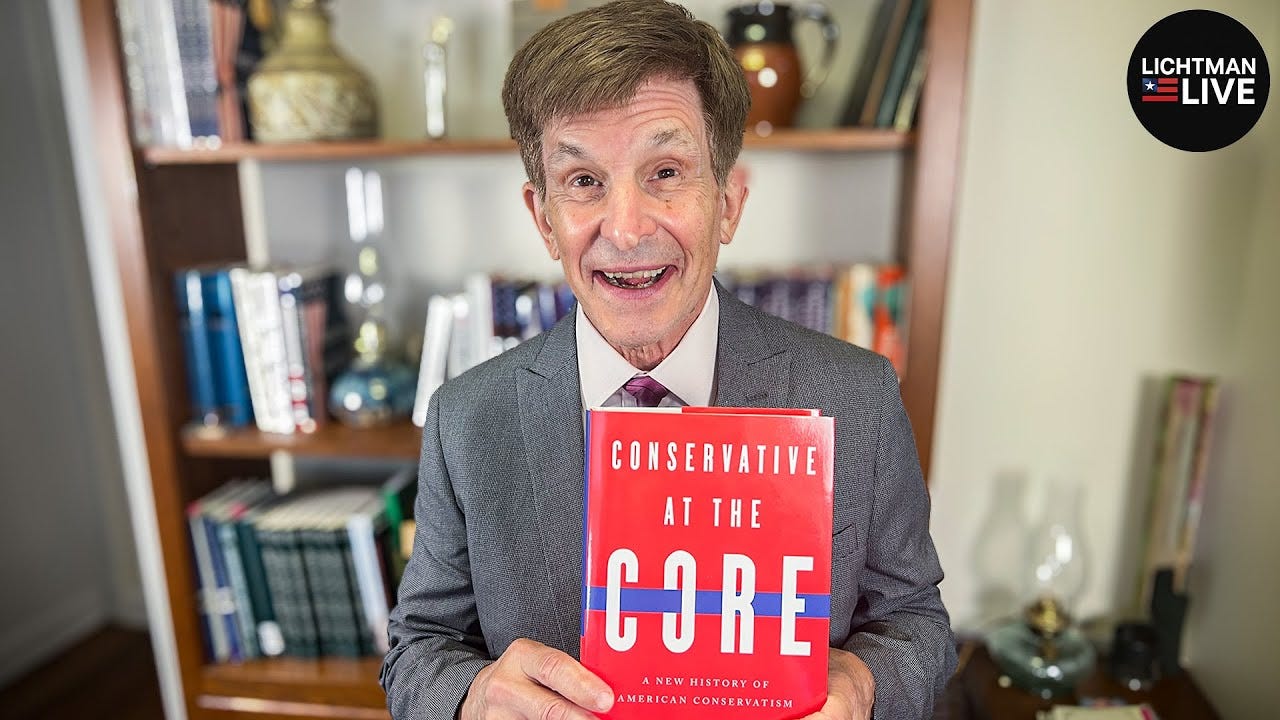
I recently spoke with American University historian Allan Lichtman about his new book Conservative at the Core. Lichtman's famous election predictions (which many had watched for years with the kind of fascination usually reserved for Jimmy the Greek-style sports handicapping) established him as "the man who called every presidential race since Reagan." Until 2024, when he didn't. But I wanted to first talk about this new book, because it does something I haven't seen done quite this cleanly and concisely: strips American conservatism down to its barest bones.1
From Steeplechase to Scholarship
Lichtman competed in steeplechase ("a race designed for horses, but run by people") and ran a 4:17 in the 1500 meters in his thirties. Just this year, both he and his wife qualified for the National Senior Olympics. She won silver in powerlifting. "My wife is 6’ of power," he said.
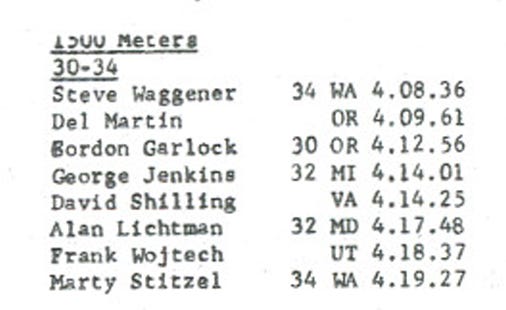
The athletic background matters because Lichtman approaches scholarship like training. You visualize before you execute. You have a plan. You know exactly what muscles you're working.
The Real Conservative Core
Conservative at the Core’s thesis cuts through a century of marketing copy. Forget limited government, free markets, fiscal responsibility, states' rights, law and order. Those are what Lichtman calls "outer belt" ideas, borrowing from philosopher of science Imre Lakatos. Dispensable, as far as actual governing behavior goes. Window dressing.
The actual "core?" Two things that haven't budged since the 1920s. First, advancing private enterprise (not free enterprise, private enterprise). Second, imposing a big-state version of traditional Christian values.
"None of these so-called professed conservative principles define the movement," Lichtman explained. "These were what we call the outer belt ideas. Totally discardable."
Consider, Lichtman says, House Speaker Mike Johnson. When asked about his political philosophy, Johnson says pick up a Bible. "That's my worldview," Lichtman quoted him as saying. But such selective readings of the Bible highlight usually highlight particularized social concerns while overlooking everything Jesus said about wealth and greed. "Remember, it was Jesus who said, it's easier for a camel to go through the eye of a needle than for a rich man to enter heaven. They utterly ignore that."
Trump, the Culmination of Conservatism
Everyone wants to paint Trump as the guy who broke conservatism and sent politicians like Liz Cheney running for the hills. Lichtman thinks that's backwards. Trump got 90% of the conservative vote in 2024. You couldn't get 90% of people to agree on much of anything.
"He got elected not because he was hijacking conservatism, but because he was saying, more boldly and more forthrightly, things that resonated with conservatives," Lichtman said. The quieter politicians like Jeb Bush or Kasich wouldn't say what Trump would.
The pattern goes back to Warren Harding, Calvin Coolidge, Herbert Hoover. Cut taxes drastically. Deregulate. Appoint business-friendly people to regulatory agencies. Help certain favored multinationals expand. "Fast forward, we find conservative governments doing this very same thing."
I mentioned watching Jeff Bezos and Mark Zuckerberg at the inauguration. In the 1920s, Andrew Mellon was simultaneously one of the richest men in America and Treasury Secretary. For several months this year, we had Elon Musk, a centibillionaire and the world's richest man working right alongside the president with DOGE.
Trump, the Populist?
"Donald Trump is not a populist. He is the opposite of what it means to be a populist," Lichtman said, getting worked up. For him, real populists were 19th-century farmers challenging business dominion. They wanted graduated income taxes and government ownership of transportation.
Trump's cabinet? Billionaires and multimillionaires, to borrow a well-used phrase from Bernie Sanders. His policies? Tax cuts, deregulation, opening federal lands to private enterprise. "What has he done for ordinary Americans? Impose tariffs that raise our prices."
The 2024 Miss
I had to ask about the election prediction. Lichtman had called them right since 1984 — though some debate his 2000 and 2016 calls — then whiffed bigly on 2024.
"I was very nervous about that prediction," he admitted. "There's a famous article that says, Lichtman, this time, doesn't have butterflies, he's got crows in his stomach."
He was furious at Democrats for publicly trashing their sitting president.2 When they united behind Harris, he eventually came around to the idea that the odds narrowly favored her. The backlash, he tells me, was vicious. Death threats. People trying to break into his home. Swatting. Doxxing.
What went wrong? Two things made 2024 unique. First, the Democrats' self-destruction. Second, "this was the ultimate misinformation election."
He offered abortion as the smoking gun. Exit polls showed pro-choice beating pro-life by 30 points. Should have powered Harris to victory in a few swing states. But after all the zone-flooding from Musk and Trump? The actual gap between Harris and Trump on abortion was just three points. Not 30. Not 15. Three.
"You can't make a rational decision under these circumstances," he said. His "Keys" system assumes a pragmatic electorate making rational choices about whether to give the incumbent party four more years. Hard to do that when people think crime is soaring (it was down, in the immediate term) and inflation is in double digits (it was, also in the immediate term, under 3%).
The Marketing Masters
Conservatives, Lichtman conceded, are brilliant marketers. Have been since the 1920s. They were using radio before FDR's fireside chats. They've totally outpaced Democrats in digital media.
"We tend to think of conservatives as kind of rubes, unsophisticated," Lichtman said. "Just the opposite is, of course, true."
They've sold their outer-belt principles so effectively that even scholars buy them. Many academics think modern conservatism started with William Buckley in 1955 or Goldwater in 1964. "They’re missing a half century or so of conservative history."
Writing Advice from a Senior Olympian
Near the end, Lichtman shifted into coach mode. His advice for writers? Visualize the whole book before writing a word. Athletes visualize their performance; writers should too.
Then answer six questions: What's the purpose? Who's the audience? What questions will you ask? What's your research plan? What's your methodology? What tone will you strike?
"I don't do outlines," he said. "But that's me."
Neither do I, I told him. Nice to hear somebody else just goes.
The Pipeline
Lichtman's got two more books coming. One updates his Great American Presidents lectures. The other looks at American insurrections that have shaped American history. His argument: elite responses to bottom-up insurrections like Black Lives Matter and top-down ones like the Tulsa Massacre have been as important as elections in shaping America.
Political history may have lost its luster for a while during the cultural turn "but there's been a real revival of political history," Lichtman said. "The mansion of history, to quote my wonderful colleague Vernon Burton, has many rooms."
Follow Allan Lichtman on YouTube, subscribe to his Substack, and order his books on Amazon. Conservative at the Core is available now.
Folks wanting a more ideas-focused account should check out either Corey Robin’s The Reactionary Mind (negative/critical) or Russell Kirk’s The Conservative Mind (positive). The latter was a formative work for me, the former an enjoyable/breezy enough read. Lichtman noted during the conversation that liberalism could support such an outer belt/core treatment, but that wasn’t his intention here (and indeed, liberalism as such is barely mentioned, except insofar as it’s serving as a foil for some core conservative agenda item).
I wasn’t nearly as worked up, but I also noted that this midstream switch would be electorally disastrous for the Democrats — senility or no senility.